
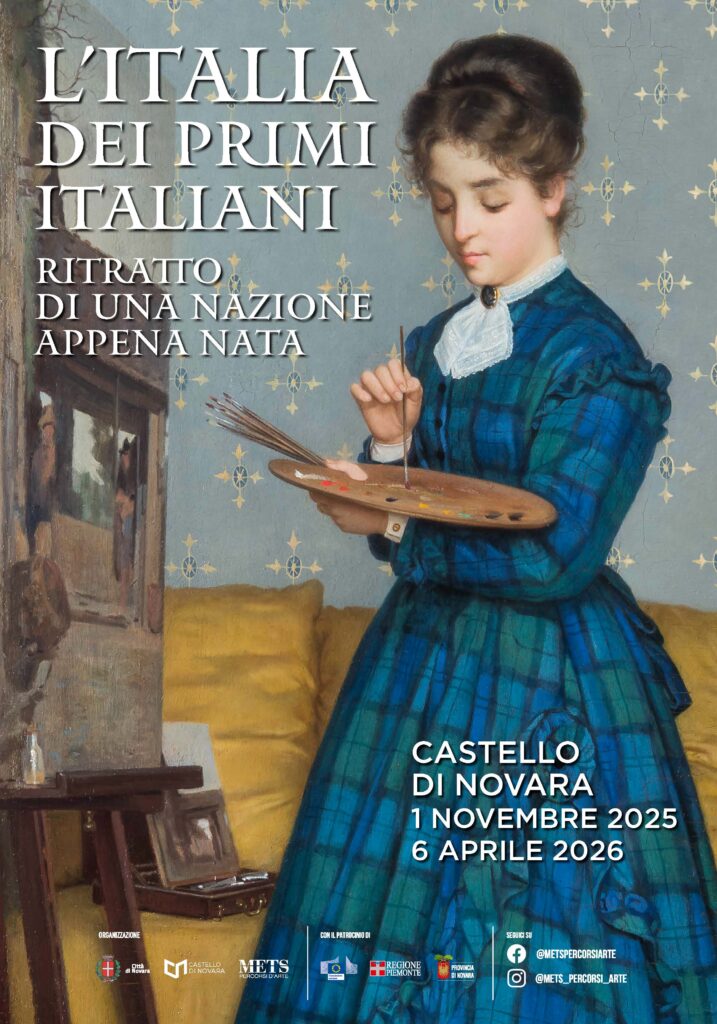
Italy of the First Italians: Portrait of a Newly-Born Nation
orario
Martedì – domenica 10.00 – 19.00 (la biglietteria chiude alle 18.00)
Aperture straordinarie: sabato 1 novembre, lunedì 8, venerdì 26 e lunedì 29 dicembre, giovedì 1, lunedì 5, martedì 6 e giovedì 22 gennaio, lunedì 6 aprile.
Aperture anticipate alle ore 9.00: Domenica 29 marzo, sabato 4 aprile e domenica 5 aprile 9.00-19.00 (la biglietteria chiude alle 18.00)
Chiuso: mercoledì 24, giovedì 25 e mercoledì 31 dicembre
Through some eighty masterpieces created between the early 1860s and the first decade of the twentieth century by leading figures of our figurative culture, this exhibition sets out to offer a comprehensive portrait of a newly unified nation – its diverse landscapes and its people – during decades marked by profound political, economic, cultural and social change. Changes which would gradually lead the country towards modernity, giving it a new face and permanently altering the customs and traditions of its inhabitants.
The exhibition is arranged in thematic sections, guiding visitors through the evocative rooms of the Castle and presenting works from prestigious public and private collections.
Curated by Elisabetta Chiodini, the show follows the resounding critical and public success of previous exhibitions: PAESAGGI. Reality, Impression, Symbol. From Migliara to Pellizza da Volpedo (2024–2025), Boldini, De Nittis et Les Italiens de Paris (2023–2024), Milan from the Romantic to the Scapigliata (2022–2023), Divisionism. The Revolution of Light (2019–2021) and The Nineteenth Century in Collection. From the Macchiaioli to Segantini (2018–2019). The Myth of Venice. From Hayez to the Biennale (2021-2022); Divisionism. The Revolution of Light (2019-2021) and The Nineteenth Century in Collection. From the Macchiaioli to Segantini (2018–2019). The exhibition is organised by METS in partnership with the Municipality of Novara and the Fondazione Castello di Novara, under the patronage of the Region of Piedmont, the European Commission and the Province of Novara. It is made possible thanks to the support of Banco BPM (Main Sponsor),Esseco S.r.l. and De Agostini Editore S.p.A.Sponsorwith contribution Artekasa S.r.l., Camporelli S.N.C., Comoli Ferrari & C. S.p.A., IGOR S.r.l., Italgrafica Novara and Mirato S.p.A., and with the collaboration of Ad Artem, the Ente Turismo Terre dell’Alto Piemonte, Big/Ciaccio Arte, EnjoyMuseum S.r.l., Enrico Gallerie d’Arte and Gallerie Maspes Milano.
The Sections
Section I – A Varied Land: Rural Life Between Plains, Valleys and Mountains
This opening section is devoted to rural Italy and the reality of peasant life, from the Alps to Sicily. The territories and everyday life of the newly unified Italians are captured through extraordinary works by artists of renown, including Telemaco Signorini (1835–1901), Giuseppe De Nittis (1846–1884), Stefano Bruzzi (1835–1911), Giovanni Battista Quadrone (1844–1898), Guglielmo Ciardi (1842–1917), Francesco Paolo Michetti (1851–1929), Angelo Morbelli (1853–1919), Carlo Fornara (1861–1978), Achille Tominetti (1848–1917) and Cesare Maggi (1881–1961).
Section II – The Coastal Development of the Peninsula and the Activities of the Maritime Regions
The second section illustrates the diversity of Italy’s coasts: predominantly high, rugged, rocky and steep along the Ligurian and Tyrrhenian seas, and generally low with sandy and pebbly beaches along the Adriatic. Over 8,000 kilometres of coastline, varying in morphology, geology, natural environments, human settlements and productive activities. These coastal landscapes and the lives of their inhabitants are documented in paintings by Giovanni Fattori (1825–1908), Vincenzo Cabianca (1827–1902), Luigi Steffani (1828–1898), Francesco Lojacono (1838–1915), Rubens Santoro (1859–1941), Mosè Bianchi (1840–1904) and others.
Section III – The Face of the Cities
This section portrays aspects of urban life in Italy’s three capitals – Turin, Florence and Rome – as well as in major cities such as Naples, Venice and, not least, Milan: the nation’s first true metropolis. More than any other, Milan aspired to modernity, embracing transformation. Exactly twenty years after the proclamation of the Kingdom of Italy, at the time of the 1881 Italian Industrial Exhibition, Giovanni Verga described it as the “most city-like City of Italy”, the moral capital of the nation, destined to play a leading role in industry and labour. Works on display include paintings by Filippo Carcano (1840–1914), Pio Joris (1843–1921), Adolfo Tommasi (1851–1933), Marco Calderini (1850–1941) and others.
Section IV – Middle Class Rituals: Leisure Time in the City and on Holiday
This section explores the “hobbies” of the middleclass , leading visitors into lush urban gardens, theatres, the softly lit salons of the elite, countryside excursions and holiday resorts. Featured artists include Ettore Tito (1859–1941), Giulio Aristide Sartorio (1860–1932), Vespasiano Bignami (1841–1929), Pompeo Mariani (1857–1927), Carlo Pittara (1835–1891) and Luigi Gioli (1855–1947).
Section V – Art in the Feminine
Entirely devoted to women, this section examines the many ways in which middleclass women engaged with the visual arts: from visiting art cities and their remarkable museums, to collecting contemporary art and frequenting the studios of leading artists, to painting for pleasure or, courageously, as a profession. Artists represented include Silvestro Lega (1826–1895), Odoardo Borrani (1833–1905) and Michele Cammarano (1835–1920).
Section VI – Venal Love
Housed in the Castle’s small cell, this section presents works on the many faces of prostitution in the nineteenth century – a subject often addressed by novelists, poets, playwrights and composers, but far more rarely by painters, among them Angelo Morbelli (1853–1919).
Section VII – Modern Times: Life in the Metropolis
The final section focuses on everyday life in Italy’s most modern cities – industrialised and increasingly populous – where luxury and destitution often existed side by side. These cities juxtaposed affluent districts with splendid new buildings for the prosperous bourgeoisie, alongside dilapidated quarters inhabited by the unemployed, forced to survive through menial labour or begging. Exceptional scenes of modern life are documented by Emilio Longoni (1859–1932), Giovanni Sottocornola (1855–1917), Angelo Morbelli (1853–1919), Attilio Pusterla (1862–1941), Francesco Netti (1832–1894), Demetrio Cosola (1851–1895) and Italo Nunes Vais (1860–1932).
Straordinari episodi di vita moderna documentati da grandi artisti tra i quali Emilio Longoni (1859-1932), Giovanni Sottocornola (1855-1917), Angelo Morbelli (1853-1919), Attilio Pusterla (1862-1941), Francesco Netti (1832-1894), Demetrio Cosola (1851-1895), Italo Nunes Vais (1860-1932).
Visitor Information
Opening Hours
Tuesday – Sunday: 10:00 am – 7:00 pm
Early opening at 9:00 am on Sunday 29 March, Saturday 4 April and Sunday 5 April (9:00 am – 7 :00 pm)
Ticket office closes at 6:00 pm
Special openings: Saturday 1 November; Monday 8, Friday 26 and Monday 29 December; Thursday 1, Monday 5, Tuesday 6 and Thursday 22 January; Monday 6 April
Closed: Wednesday 24, Thursday 25 and Wednesday 31 December
Tickets
Full price: €15.00
Open ticket: €17.00 (flexible, open date entry)
Reduced: €13.00 (weekends and public holidays)
Weekday reduced: €11.00 (Tuesday to Friday, excluding public holidays)
For details on tickets and promotions, see the menu on this page (right-hand side).
Pre-sale fee: €1.80 (online, call centre).
Audioguides
Available in Italian and English, are included in the ticket price.
Press Office
Clarart | info@clarart.com
Organizzatori
Comune di Novara
Mets percorsi d’Arte
Fondazione Castello di Novara
Altre mostre e eventi